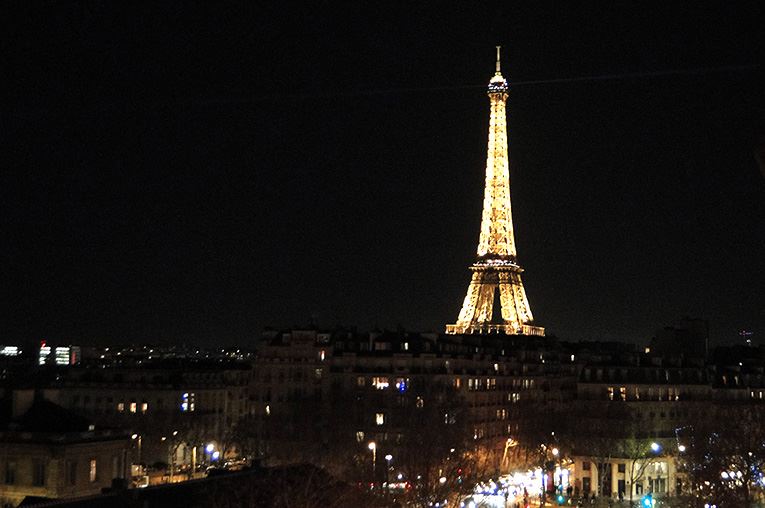
We are often asked exactly which neighborhood we are in. The 7th arrondissement has four administrative districts, and Gros-Caillou is the one that stretches between avenue Duquesne and the Seine: the Eiffel Tower, the Champ de Mars, rue Saint-Dominique, and rue Cler. That's where we send our guests when they want a simple dinner, a last-minute errand, or a walk that isn't on everyone else's itinerary.
Where Gros-Caillou begins and ends
Gros-Caillou is the 28th administrative district of Paris: 138 hectares and just over 24,000 inhabitants at the 2016 census. Coming from Les Invalides, you enter it once you pass rue de la Tour-Maubourg. The Champ de Mars borders it to the west, the Seine to the north. The Musée du Quai Branly and the Musée des Égouts de Paris are on its territory, as is the Eiffel Tower.
To get there, metro line 8 crosses the district and RER C stops at Pont de l'Alma. From our hotel, on avenue Duquesne, you can walk there: it's our direct neighbor.
The origin of the name
The name most likely comes from a boundary marker: a large block of stone, perhaps very old, that marked the limit between the lands of the Abbey of Saint-Germain and those of Sainte-Geneviève. The first mentions of it date from 1510 and 1523. The place was also called Vert-Buisson.
For a long time, there was nothing here: the Grenelle plain was made up of fields, vegetable gardens, and hunting grounds. The first inhabitants arrived at the end of the 17th century, craftsmen and workers from the construction site of Les Invalides, then from the École Militaire in the following century. That's why the neighborhood has kept shopping streets on a village scale rather than grand avenues.
The Île des Cygnes that no longer exists
Part of the district is built on a former island. The Île des Cygnes was separated from the bank by a branch of the Seine, the petite Seine, filled in starting in 1786 and then completely in 1812, where the Eiffel Tower stands today. Rue de l'Université, between rue Surcouf and avenue Bosquet, roughly follows the course of this old channel. When you walk up it, you are walking on the bed of a branch of the river. Later, a large tobacco factory occupied these grounds; it was demolished in 1909.
The Fontaine de Mars, rue Saint-Dominique
This is the first place we point out. The Fontaine de Mars, also called the Fontaine du Gros-Caillou, sits at the center of a small arcaded square, between 129 and 131 rue Saint-Dominique. It was built from 1806 to 1808 based on plans by engineer François-Jean Bralle, with bas-reliefs by Pierre-Nicolas Beauvallet. It has been listed as a historic monument since 1926.
Look at the side facing the street: Mars, god of war, appears alongside Hygieia, goddess of health. The choice is explained by the Gros-Caillou military hospital, founded in 1759 directly opposite and demolished in 1896. The arcaded square around it dates from 1859. At the foot of the fountain, a marker indicates the level reached by the 1910 flood, even though the Seine flows 570 meters away. Of the three bronze mascarons that spout water near the ground, only one still works.
Under the arcades, at number 129, the restaurant La Fontaine de Mars serves French bistro cuisine. We recommend booking, especially in the evening.
Rue Saint-Dominique and rue Cler
Rue Saint-Dominique is the neighborhood's shopping street, along with rue Cler and rue de Grenelle. You'll find places to do your grocery shopping, terraces, and local boutiques rather than department store chains. In the evening, this is where we send guests who want to dine without crossing Paris.
Rue Cler, partly pedestrianized, is the street for greengrocers, cheese shops, and caterers. We have dedicated an entire page to it with the days and hours of the nearby Saxe-Breteuil market; if you are staying with us for several days, this is where you'll do your shopping.
The Champ de Mars and the Eiffel Tower
The Champ de Mars closes off the district to the west. It's a garden for local residents as much as for visitors: you cross it to get to the Eiffel Tower, you sit there at the end of the day. For what you can really do there, the tower's sparkling schedule, and the best viewpoints, we have written dedicated pages, linked below.
Two museums on the banks of the Seine
The Musée du Quai Branly is dedicated to the arts of Africa, Asia, Oceania, and the Americas. Allow half a day; we have detailed its opening hours and late-night opening in a separate article.
The Musée des Égouts de Paris can be visited under the Pont de l'Alma, on the left bank. This is the visit we suggest to families and the curious who have already done the major museums: you understand how the city works beneath your feet.
And in the evening, back with us
After a day in Gros-Caillou, our bar is two streets away, on the avenue Duquesne side: a discreet bar, in the speakeasy spirit, with classic cocktails and chef-driven cuisine. If you are looking for a room to explore the neighborhood, our Double Room with View and our Junior Suite with View look out onto the Eiffel Tower.